

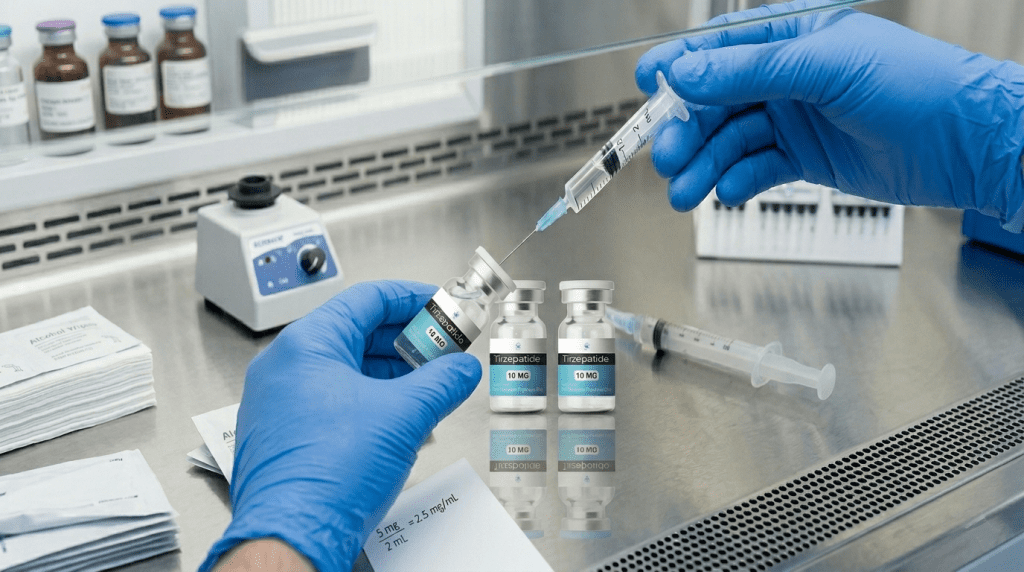

A Comprehensive Guide
Introduction
Peptide reconstitution is a fundamental procedure in biochemical research, pharmaceutical development, and molecular biology studies. Research peptides are typically supplied in lyophilized (freeze-dried) form to ensure stability during storage and shipping. Proper reconstitution is crucial for maintaining peptide integrity, biological activity, and experimental reproducibility.
This guide provides a video and detailed protocols for safely and effectively reconstituting research peptides while preserving their structural and functional properties.
Understanding Peptide Structure and Stability
What Are Research Peptides?
Research peptides are short chains of amino acids (typically 2-50 residues) used in:
- Drug discovery and development
- Biochemical pathway studies
- Protein-protein interaction research
- Enzyme activity assays
- Cell culture experiments
Why Lyophilization?
Lyophilization removes water while preserving peptide structure through:
- Reduced degradation: Eliminates hydrolysis and oxidation
- Extended shelf life: Prevents bacterial growth and chemical breakdown
- Improved stability: Maintains structural integrity during storage
- Enhanced solubility: Removes aggregation-promoting factors
Pre-Reconstitution Considerations
1. Peptide Characterization
Before reconstitution, review:
- Molecular weight: Determines concentration calculations
- Amino acid sequence: Identifies hydrophobic/hydrophilic regions
- Isoelectric point (pI): Affects solubility at different pH values
- Post-translational modifications: May require specific handling
- Known stability issues: Oxidation-prone residues (Cys, Met, Trp)
2. Storage Conditions
Proper storage before reconstitution:
- Temperature: Store at -20°C or -80°C
- Humidity: Keep in desiccated environment
- Light exposure: Protect from UV light
- Container integrity: Ensure sealed vials
3. Laboratory Setup
Prepare a clean workspace with:
- Sterile technique: Use laminar flow hood if available
- Appropriate PPE: Gloves, lab coat, safety glasses
- Calibrated equipment: Micropipettes, analytical balance
- Quality reagents: High-purity solvents and buffers
Reconstitution Procedures
Step 1: Initial Assessment
- Visual inspection: Check for unusual coloration or texture
- Weight verification: Confirm peptide mass matches specifications
- Vial condition: Ensure no cracks or contamination
- Documentation: Record lot numbers and expiration dates
Step 2: Solvent Selection
Choose appropriate solvent based on peptide properties:
For Hydrophilic Peptides:
- Sterile water (pH ~7.0)
- Phosphate-buffered saline (PBS)
- Tris-HCl buffer (pH 7.4-8.0)
For Hydrophobic Peptides:
- DMSO (dimethyl sulfoxide) – up to 100%
- Water/DMSO mixtures (start with 10-50% DMSO)
- Dilute acetic acid (0.1-1%) for basic peptides
- Dilute ammonia (0.1%) for acidic peptides
For Problematic Peptides:
- Acetonitrile/water (10-50% ACN)
- Methanol/water (10-30% MeOH)
- Guanidine HCl (2-6 M) for aggregation-prone peptides
Step 3: pH Optimization
Adjust pH for optimal solubility:
- Acidic peptides (pI < 5): Use pH 8-9
- Basic peptides (pI > 8): Use pH 3-5
- Neutral peptides: Use pH 6-7
Step 4: Reconstitution Protocol
Method A: Direct Dissolution
- Calculate required solvent volume for desired concentration
- Add solvent to vial wall (not directly onto peptide)
- Gently swirl or vortex at low speed
- Allow 5-10 minutes for complete dissolution
- Check for clarity and absence of particulates
Method B: Sequential Dilution
- Add small volume of appropriate solvent (10-50% of final volume)
- Ensure complete dissolution
- Dilute to final volume with buffer or water
- Filter through 0.22 μm filter if needed
Method C: Problematic Peptides
- Pre-wet peptide with DMSO (5-10 μL)
- Add aqueous solvent gradually
- Sonicate briefly if aggregation occurs
- Centrifuge to remove insoluble material
Step 5: Concentration Determination
Verify peptide concentration using:
- UV spectrophotometry (280 nm for Trp/Tyr-containing peptides)
- BCA or Bradford assays for total protein
- Amino acid analysis for precise quantification
- HPLC analysis for purity assessment
Successful peptide reconstitution requires careful consideration of peptide properties, appropriate solvent selection, and proper technique execution. Following these protocols will help ensure consistent results while maintaining peptide integrity and biological activity.
Key success factors include:
- Understanding peptide physicochemical properties
- Selecting appropriate reconstitution conditions
- Implementing proper quality control measures
- Following safety protocols throughout the process
Regular practice and attention to detail will improve proficiency and experimental outcomes in peptide-based research applications.