



Disclosure: We earn a commission on purchases made through links in this article. Our recommendations reflect published research and product formulation, not commission rates.
Evaluating an energy supplement during GLP-1 therapy comes down to five checks: stimulant content, ingredient transparency, evidence behind the actives, manufacturing standards, and cost per serving. Supplements receive no FDA pre-approval, so nothing on a shelf has been vetted before it reaches you. The label carries the information, and most of what matters sits in the fine print rather than the front panel. Our article on energy during GLP-1 therapy covers why fatigue happens. This one covers how to judge what you are buying.
Check One: Stimulant Content
Read the label for caffeine, caffeine anhydrous, guarana, yerba mate, green tea extract, and synephrine before anything else. Front-panel marketing rarely announces stimulant content, and several of these names sit in the ingredient list without the word caffeine appearing anywhere.
Stimulant-free products state it explicitly on the label. Absence of the claim usually means stimulants are present.
Check Two: Ingredient Transparency

A transparent label states the milligram amount of every active ingredient. Proprietary blends list ingredients together under one total, which hides how much of each you are actually getting.
Blends allow a formula to name an impressive ingredient while including a fraction of the amount used in research. A named ingredient at an undisclosed dose tells you nothing about what the product does.
Look for the milligram figure beside each name. No figure, no way to evaluate.
Check Three: Evidence Behind the Actives
Branded, patented ingredients carry published human research that generic extracts generally do not. Generic ingredient names on a label can come from any source at any standardization level.
Branded compounds are trademarked, standardized to a specific concentration, and studied under that trademark. Eriomin, Morosil, and CaloriBurn GP are examples of branded compounds with published human research behind their inclusion.
Search the trademark name plus “study” to see what exists. Formulas that avoid naming their sources usually have a reason.
Check Four: Manufacturing Standards
Supplements are not approved before sale, so manufacturing certification is the only quality signal on the label. Four markers carry weight:
- cGMP compliance. Current Good Manufacturing Practice certification covers facility standards.
- Third-party testing. Independent verification that contents match the label.
- Country of manufacture. Domestic production is subject to FDA facility inspection.
- Additive disclosure. Formulas stating they are free of fillers and unnecessary additives have committed to something checkable.
Check Five: Cost Per Serving
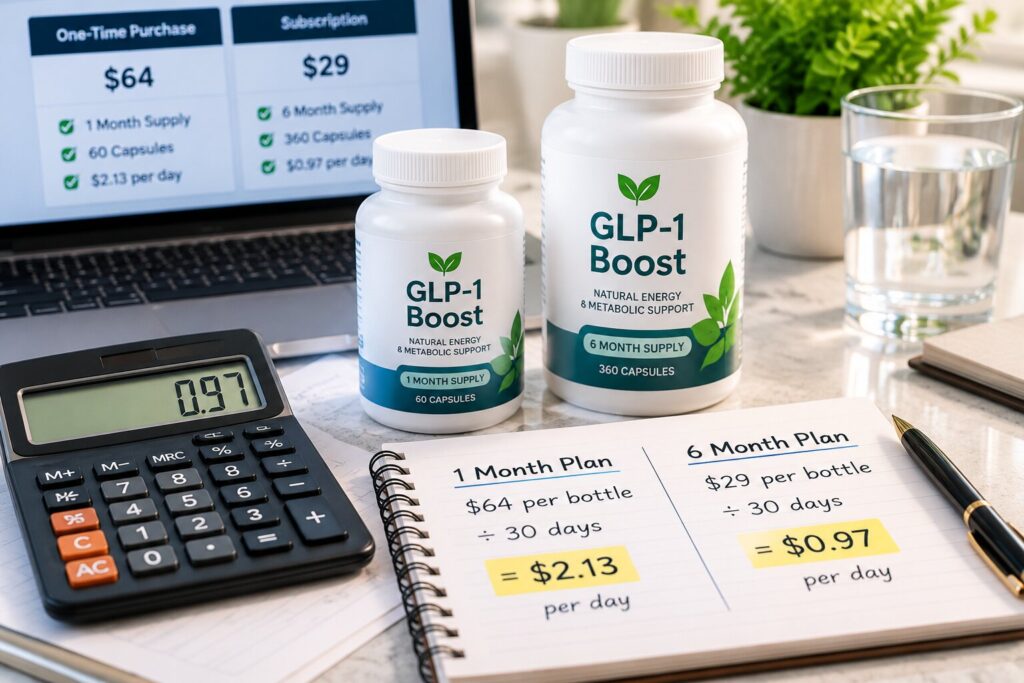
Compare supplements by cost per day rather than by bottle price, since bottle sizes and serving counts vary. Divide the bottle price by the number of days it covers.
Subscription and multi-month pricing changes the figure substantially. GLP-1 Boost illustrates the spread: $64 for a single month works out near $2.13 per day, while the six-month plan at $29 per bottle drops closer to $0.97 per day. The product itself does not change between those two numbers.
Weigh that against the commitment. A multi-month price only saves money on a product you keep using.
Marketing Red Flags
Specific numerical outcome claims on a supplement are the clearest warning sign. Products are permitted to describe how ingredients support normal body functions. Claims that a supplement produces a named amount of weight loss, or treats a condition, fall outside what the category allows.
Four more signals worth noticing:
- Before and after photographs presented as typical results
- Countdown timers and stock-remaining counters that reset on reload
- Testimonials with no way to verify the person exists
- Any suggestion that a supplement replaces prescription medication
Return Policy and Commitment Terms
A meaningful return window lets you evaluate a product over a realistic trial period. Nutritional interventions take weeks, so a 14-day window ends before there is anything to judge.
Check three terms before purchase: the length of the guarantee, whether opened bottles qualify, and who pays return shipping. Subscription terms matter equally. Confirm how to skip, reschedule, or cancel before the first renewal rather than after.
GLP-1 Boost carries a 60-day money-back guarantee with free shipping and returns, and its subscription allows skipping, rescheduling, editing, or cancelling deliveries. The formula is stimulant-free, non-GMO, gluten-free, made in the USA, and free of additives and fillers.
View GLP-1 Boost pricing and options
Frequently Asked Questions
What does “proprietary blend” mean on a supplement label?
Several ingredients grouped under one combined weight, with individual amounts undisclosed. The practice is legal and makes independent evaluation impossible.
How do you verify third-party testing?
Look for a certificate of analysis on the manufacturer’s site, or a testing organization’s seal with a lot number you can check.
Is a subscription better than a one-time purchase?
Per-day cost drops with subscription and multi-month plans. Start with a single month if you are unsure, then move to a longer plan once you know you will continue.
How long should you give a supplement before judging it?
Eight to sixteen weeks of consistent use. Guarantee windows shorter than that end before the evaluation period does.
These statements have not been evaluated by the Food and Drug Administration. This product is not intended to diagnose, treat, cure, or prevent any disease. Consult your healthcare provider before adding a supplement alongside prescription medication.