



For decades, weight loss interventions have largely relied on willpower, calorie restriction, and exercise. While foundational, these approaches often fail to address the biological drivers of hunger and metabolism. That’s why the rapid expansion of GLP-1 (glucagon-like peptide-1) research is a watershed moment for weight management. By targeting the body’s natural satiety pathways, GLP-1 peptides offer a scientifically grounded alternative to yo-yo dieting.
How GLP-1 Works Naturally
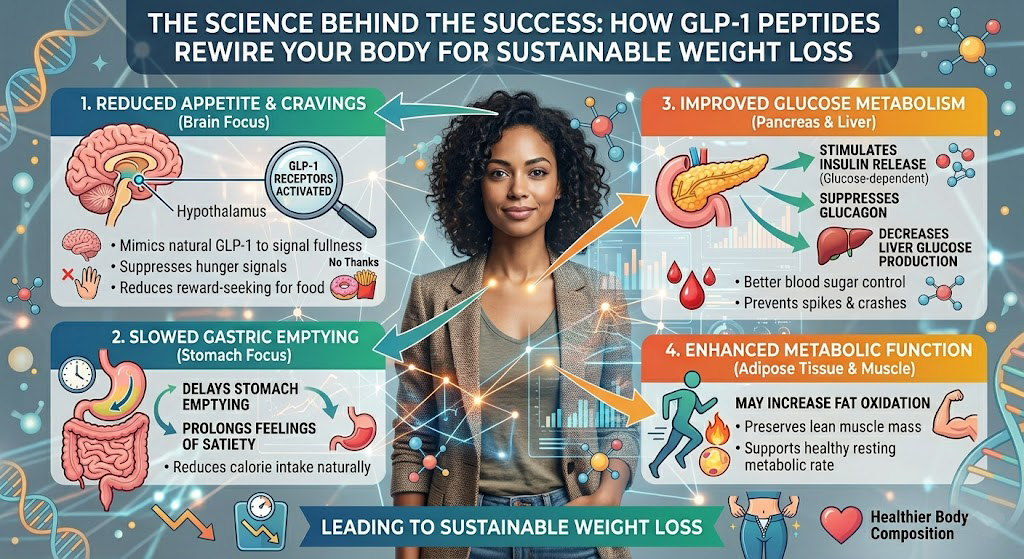
GLP-1 is an incretin hormone produced in the gut after eating. Its job is straightforward: signal the brain that you’re full, slow gastric emptying, and stimulate insulin release while suppressing glucagon. In people with obesity or insulin resistance, this natural signaling pathway is often blunted. GLP-1 research focuses on developing stable peptide analogs that mimic and amplify this hormone’s effects, effectively restoring the body’s built-in fullness cues.
GLP-1 is an incretin hormone produced in the gut after eating. Its job is straightforward: signal the brain that you’re full, slow gastric emptying, and stimulate insulin release while suppressing glucagon. In people with obesity or insulin resistance, this natural signaling pathway is often blunted. GLP-1 research focuses on developing stable peptide analogs that mimic and amplify this hormone’s effects, effectively restoring the body’s built-in fullness cues.
What the Research Reveals
Over the past decade, randomized controlled trials have consistently demonstrated that GLP-1 receptor agonists can produce 10–20% body weight reduction over 12–18 months when combined with lifestyle modifications. Importantly, research shows this isn’t just water weight or muscle loss. Studies using DEXA scanning indicate preserved lean mass when adequate protein and resistance training are maintained, a critical factor for long-term metabolic health.
Over the past decade, randomized controlled trials have consistently demonstrated that GLP-1 receptor agonists can produce 10–20% body weight reduction over 12–18 months when combined with lifestyle modifications. Importantly, research shows this isn’t just water weight or muscle loss. Studies using DEXA scanning indicate preserved lean mass when adequate protein and resistance training are maintained, a critical factor for long-term metabolic health.
Why This Matters for Weight Loss Seekers
Traditional diets fight against biology; GLP-1 research works with it. By reducing spontaneous caloric intake, decreasing food reward sensitivity, and improving metabolic flexibility, these peptides help create a sustainable energy deficit without the extreme hunger that derails most diets. Ongoing research is also refining delivery methods, dosing schedules, and combination therapies to maximize efficacy while minimizing disruption to daily life.
Traditional diets fight against biology; GLP-1 research works with it. By reducing spontaneous caloric intake, decreasing food reward sensitivity, and improving metabolic flexibility, these peptides help create a sustainable energy deficit without the extreme hunger that derails most diets. Ongoing research is also refining delivery methods, dosing schedules, and combination therapies to maximize efficacy while minimizing disruption to daily life.
Looking Ahead
The science is still evolving. Researchers are actively studying oral GLP-1 formulations, longer-acting versions requiring fewer injections, and dual/triple agonist peptides that target multiple metabolic pathways simultaneously. For those seeking lasting weight loss, this research pipeline means increasingly accessible, personalized, and physiologically aligned tools are on the horizon.
The science is still evolving. Researchers are actively studying oral GLP-1 formulations, longer-acting versions requiring fewer injections, and dual/triple agonist peptides that target multiple metabolic pathways simultaneously. For those seeking lasting weight loss, this research pipeline means increasingly accessible, personalized, and physiologically aligned tools are on the horizon.
GLP-1 peptide research isn’t just about helping people lose weight—it’s about helping them keep it off by addressing the root biological drivers of overeating. As the science matures, weight loss is transitioning from a test of discipline to a manageable metabolic condition.