



Disclosure: We earn a commission on purchases made through links in this article. Our recommendations reflect published research and product formulation, not commission rates.
Getting enough protein on tirzepatide is a volume problem rather than a knowledge problem. Most people know they need protein. What changes on tirzepatide is that appetite suppression runs deeper than on semaglutide, which leaves less room on the plate for anything. Strategy has to shift toward protein density per bite, liquid sources, and timing that works with a stomach that fills early and empties slowly.
Why Tirzepatide Makes Protein Harder
Tirzepatide acts on two receptors rather than one, which produces stronger appetite suppression than single-agonist medications. The SURMOUNT-1 trial reported average weight loss of 22.5 percent over 72 weeks, ahead of what semaglutide trials show.
That result comes with a matching constraint. Deeper appetite suppression means smaller total food volume, and smaller volume makes every gram of protein harder to fit. Weight coming off faster also raises the lean tissue stakes, since steeper losses draw more heavily on muscle.
Protein becomes the limiting nutrient rather than one of several considerations.
Protein Density Per Bite

Choose sources that deliver the most protein in the least volume, because volume is the constraint that matters now. Density separates workable choices from ones that fill the stomach before they deliver.
High-density sources worth prioritizing:
- Chicken breast, turkey, and lean beef
- White fish, tuna, and shrimp
- Egg whites alongside whole eggs
- Greek yogurt and cottage cheese
- Whey, casein, or plant protein isolate
Lower-density sources such as beans, lentils, and nuts deliver protein alongside considerable volume and fat. They stay useful in small amounts and work poorly as the backbone of a daily target on tirzepatide.
Liquid Protein Fills the Gap
Liquid sources bypass the volume problem because liquids leave the stomach faster than solid food. A shake delivering 25 to 30 grams occupies less stomach capacity than the equivalent in chicken.
Three applications work well:
- Replace a meal you cannot finish. A shake completed beats a plate half eaten.
- Add protein to what you already drink. Unflavored isolate mixes into coffee, milk, or smoothies without adding bulk.
- Cover the evening gap. Appetite often runs lowest late in the day, which is where daily targets are usually missed.
Liquid protein supplements solid food rather than replacing it. Whole foods carry micronutrients and fiber that isolates do not.
Timing Around Dose Days
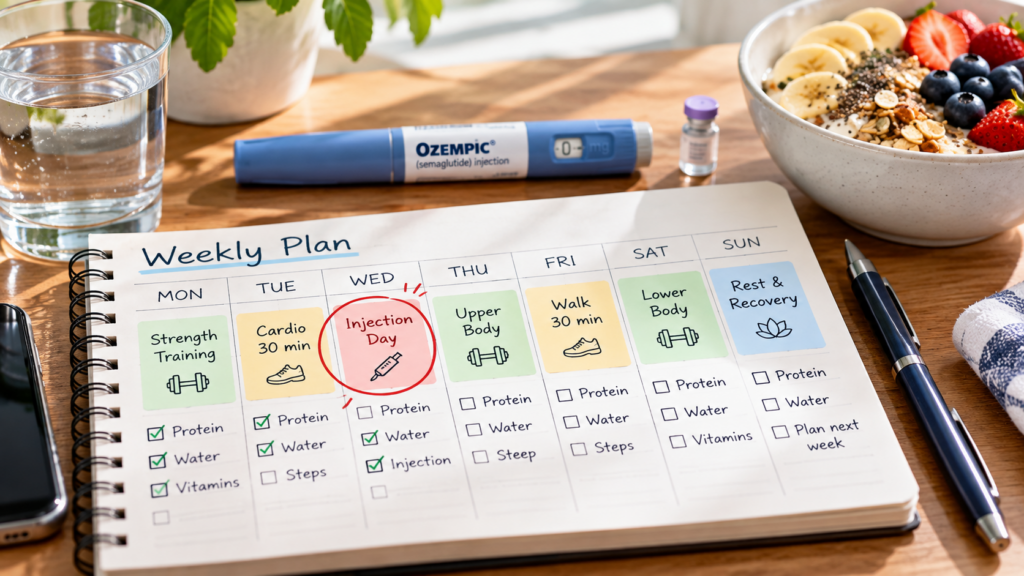
Appetite suppression peaks in the days following a tirzepatide injection and eases toward the end of the weekly cycle. Most people notice the pattern within the first month.
Work with it rather than against it. Prioritize protein on the days appetite allows more intake, and lean on liquid sources through the days after injection. Weekly protein totals matter more than perfect daily consistency when the appetite itself runs on a weekly rhythm.
Each dose increase resets the pattern for a week or two before intake settles again.
Eating Order and Portion Structure
Protein first at every meal, without exception, because fullness arrives before the plate empties. Whatever sits last on the plate is what goes uneaten.
Plate composition follows the same logic as any GLP-1 meal, covered in our guide to GLP-1 meal planning. What changes on tirzepatide is proportion. Protein occupies more of a smaller plate, vegetables shrink to a side rather than a bulk item, and carbohydrates and fat fill whatever capacity remains.
Cut protein into smaller pieces and eat slowly. Large pieces of dense meat sit heavily in a stomach that empties slowly.
Protein and the Muscle Question
Protein supplies the material for muscle retention, and resistance training supplies the signal. Neither substitutes for the other, and the specifics of that relationship sit in our guide to preserving lean mass during dieting.
RightWell GLP-1 Boost is a stimulant-free supplement supporting appetite control, metabolic balance, and blood sugar stability across every stage of a GLP-1 journey. The formula combines Eriomin lemon bioflavonoid complex, Morosil red orange extract, and CaloriBurn GP grains of paradise. The product is non-GMO, gluten-free, and made in the USA, priced from $29 to $64 per bottle with a 60-day money-back guarantee.
View GLP-1 Boost pricing and options
Frequently Asked Questions
Is protein harder to hit on tirzepatide than semaglutide?
Generally yes, since dual receptor action suppresses appetite more deeply. The strategies are the same, applied with more deliberate effort.
Do protein shakes cause digestive discomfort on tirzepatide?
Some people find whey concentrate sits poorly. Isolate contains less lactose, and plant-based options suit people who react to dairy.
Should protein intake change as the dose increases?
The target stays tied to body weight. What changes is how much of it needs to come from liquid sources during escalation weeks.
What if you cannot reach the protein target at all?
Get as close as consistently possible and speak with your prescriber. Persistent inability to eat warrants a dosing conversation rather than continued effort alone.
These statements have not been evaluated by the Food and Drug Administration. This product is not intended to diagnose, treat, cure, or prevent any disease. Consult your healthcare provider about nutrition during prescription treatment.