


Disclosure: We earn a commission on purchases made through links in this article. Our recommendations reflect published research and product formulation, not commission rates.
Telehealth made GLP-1 prescriptions accessible, and the wide variation between programs is what determines whether results last. Some provide a prescribing clinician, ongoing monitoring, nutrition support, and a plan for what happens when therapy ends. Others provide a questionnaire and a shipment. Both call themselves telehealth. The difference shows up roughly a year in, when the medication stops and whatever structure was built has to carry the results.
What Telehealth Changed
Remote prescribing removed the geographic and scheduling barriers that kept many people from weight-management care. Rural patients without a nearby specialist, people whose work makes daytime appointments difficult, and anyone deterred by in-person weight discussions all gained access.
The model also lowered the barrier for programs built on volume rather than care. Both things happened at once, which is why evaluation matters more here than in traditional care.
What Separates a Clinical Program
A clinical telehealth program provides a named prescriber, follow-up appointments, lab monitoring, and a response channel between visits. A prescription pipeline provides a form and a delivery schedule.
Five markers distinguish them:
- A named, licensed prescriber you can identify and who is licensed in your state
- Bloodwork before prescribing, rather than a questionnaire alone
- Scheduled follow-ups rather than automatic refills
- A route to reach someone about side effects between appointments
- Transparency about what is dispensed, including whether it is the approved branded medication
The regulatory side of what gets dispensed sits in our guide to prescription versus compounded options.
Questions Before Enrolling
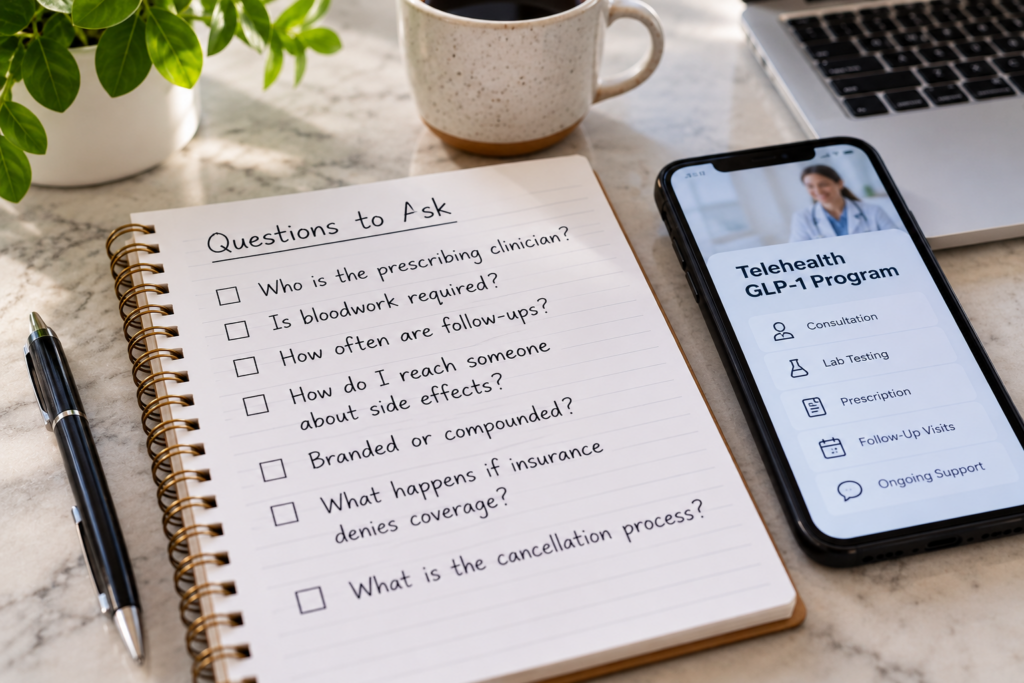
Asking these before paying surfaces most problems.
- Who is the prescribing clinician, and are they licensed in my state?
- Is bloodwork required before the first prescription?
- How often are follow-up appointments, and are they included in the price?
- How do I reach someone about side effects outside an appointment?
- Is this the FDA-approved branded medication?
- What happens to the cost if my insurance denies coverage?
- What is the cancellation process?
Vague answers on the prescriber or on what is dispensed are the ones that matter most.
The Gap That Costs Results
Most telehealth programs end at the prescription, and the prescription is the smallest part of lasting weight management. Nutrition structure, resistance training, and a maintenance plan determine what remains afterward.
Appetite returns when medication signaling decreases. Habits built during therapy are what hold results at that point. A program that never addresses nutrition or training has left the hardest part entirely to the patient.
Ask directly whether the program includes nutrition guidance, whether anyone discusses muscle retention, and what the plan is for ending therapy. Our guides to preserving lean mass during dieting and GLP-1 meal planning cover both.
What Sustainable Means Here

Sustainable weight loss means the result holds after the intervention ends, which makes the exit plan part of the program rather than an afterthought.
Three things carry forward: protein habits established while appetite was suppressed, training consistency built during the loss phase, and meal structure that functioned without hunger cues. None of those arrive with the prescription.
RightWell GLP-1 Boost is a stimulant-free supplement supporting appetite control, metabolic balance, and blood sugar stability across every stage, including the transition period after therapy ends. The formula combines Eriomin lemon bioflavonoid complex, Morosil red orange extract, and CaloriBurn GP grains of paradise. The product is non-GMO, gluten-free, and made in the USA, priced from $29 to $64 per bottle with a 60-day money-back guarantee.
View GLP-1 Boost pricing and options
Frequently Asked Questions
Is telehealth GLP-1 prescribing legitimate?
Remote prescribing by a licensed clinician is standard medical practice. What varies is the depth of clinical oversight behind it.
Can a telehealth program prescribe the branded medication?
Yes. Ask directly, since some programs dispense compounded preparations instead and the distinction matters.
Does insurance cover telehealth GLP-1 programs?
Coverage depends on the plan and the provider. Many programs operate on cash pay outside insurance entirely.
What should you do if a telehealth program stops responding?
Transfer care to a prescriber who responds, and request your records. Continuity matters more than staying with the original program.
These statements have not been evaluated by the Food and Drug Administration. This product is not intended to diagnose, treat, cure, or prevent any disease. Consult a licensed healthcare provider about any prescription treatment decision.