



Disclosure: We earn a commission on purchases made through links in this article. Our recommendations reflect published research and product formulation, not commission rates.
Compounded semaglutide lost its primary legal basis when the FDA declared the shortage resolved, and mass-produced compounded copies are no longer permitted. The agency removed semaglutide from its drug shortage list in February 2025 and set enforcement deadlines that ended large-scale compounding for most pharmacies. A narrow exception survives for individual prescriptions with documented clinical need. Anyone still being offered compounded semaglutide at scale in 2026 is buying from a source operating outside those rules. healthfactsjournal
What Compounding Means
Compounded drugs are prepared by pharmacies rather than manufactured and approved by the FDA. Two categories exist under federal law. State-licensed 503A pharmacies fill prescriptions for individual patients. FDA-registered 503B outsourcing facilities produce larger volumes under manufacturing standards.
Neither category receives FDA approval for the compounded product itself. Approval covers the branded medication, not a pharmacy’s version of it.
Why Compounded GLP-1 Became Widely Available
Federal law permits compounding a copy of an approved drug while that drug sits on the FDA shortage list. Semaglutide demand outpaced supply through 2023 and 2024, which placed it on that list and opened the exemption.
Telehealth platforms built entire businesses on it. Prices ran far below branded medication, and access required no waiting list.
What Changed
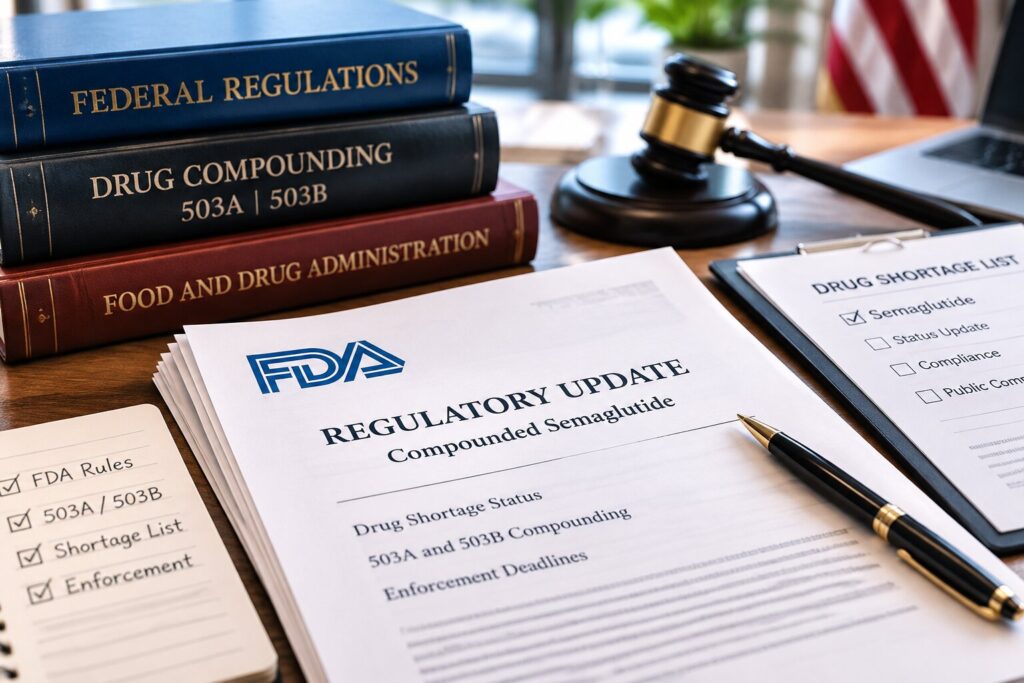
Removal from the shortage list ended the exemption that made the market possible. 503B facilities were given until May 22, 2025 to wind down, and courts have so far upheld the FDA’s position. meto
The position in 2026 breaks down as follows:
- Mass-produced compounded semaglutide. No longer permitted where it is not patient-specific. healthfactsjournal
- 503A patient-specific compounding. Still possible when a prescriber documents a specific clinical need an approved product cannot meet. precisiontelemed
- 503B bulk production. The FDA proposed on April 30, 2026 to remove semaglutide and tirzepatide from the 503B bulks list, which would block large-scale compounding outright. The public comment period was extended to July 30, 2026. lotilabsmedmatrixusa
- Branded medication through telehealth. Fully permitted and unaffected.
Major telehealth platforms exited compounded semaglutide after FDA enforcement attention. telehealthally
The Salt Form Problem
Approved semaglutide products use the base form of the molecule. Salt forms such as semaglutide sodium are not the approved active ingredient. Some compounded products have used these salt variants rather than the base form. healthonmeto
That distinction matters because the clinical trial data supporting semaglutide applies to the approved form. Purity, concentration, and dosing accuracy in a compounded preparation are not covered by the approval that produced those results.
Questions to Ask Any Source

Verification falls on the buyer when a product sits outside FDA approval. Six questions surface most problems:
- Is this the FDA-approved branded medication or a compounded preparation?
- Which pharmacy prepares it, and is it 503A or 503B?
- Is the pharmacy licensed in your state?
- Which form of the molecule does it contain?
- Does a licensed prescriber evaluate you before dispensing?
- What clinical need is documented if this is patient-specific compounding?
Vague answers on any of these are the answer.
Where Non-Prescription Options Sit
Adults who do not meet prescription criteria, or who prefer a non-prescription route, sit outside this regulatory question entirely. Dietary supplements operate under a separate framework and are not compounded copies of a drug.
RightWell GLP-1 Boost is a stimulant-free supplement supporting appetite control, metabolic balance, and blood sugar stability. The formula combines Eriomin lemon bioflavonoid complex, Morosil red orange extract, and CaloriBurn GP grains of paradise. The product is non-GMO, gluten-free, and made in the USA, priced from $29 to $64 per bottle with a 60-day money-back guarantee.
A supplement is not a substitute for prescription treatment, and anyone who meets clinical criteria for GLP-1 therapy should have that conversation with a physician. Our comparison of GLP-1 medications and supplements covers where each fits.
View GLP-1 Boost pricing and options
Frequently Asked Questions
Is compounded semaglutide illegal in 2026?
Patient-specific compounding by a 503A pharmacy remains permitted, while bulk 503B compounding is the subject of an active FDA proposal. Mass-produced versions sold without individual clinical documentation fall outside the rules. glpverdict
What happens to people currently using a compounded version?
Speak with the prescribing clinician about transitioning to an approved product. Stopping abruptly without a plan leaves appetite and weight management without support.
Does compounded semaglutide work the same as branded?
Clinical trial data applies to the approved product and its approved form. A compounded preparation has not been through that testing.
Why is compounded semaglutide cheaper?
Compounded preparations carry none of the development, trial, and approval costs behind a branded medication. Price reflects that gap rather than an equivalent product sold for less.
These statements have not been evaluated by the Food and Drug Administration. This product is not intended to diagnose, treat, cure, or prevent any disease. Regulatory status described here reflects publicly reported information and is not legal or medical advice. Consult a licensed healthcare provider about any prescription treatment decision.